Steve took relatively few rosary pictures, and this was the first. We'd brought a "prop" rosary from home, but the priest volunteered to get his personal one to use. It was the first time we'd seen this particular style of penal rosary. The Connemarra marble stones are identical to those in the rosary we brought as a prop. Our rosary was one brought back from a trip to Ireland several years ago, But unlike ours, made from marble beads that are still sharp, hard cubes, this one had the patina of age and use. The stone beads are worn smooth with use, and they slide easily through the fingers, sharp stone made comforting and familiar by countless small touches and voiced prayers.
The one decade rosary is often called the penal rosary. I had assumed it was so named for the common practice of giving a decade of the rosary as a penance after confession. It wasn't until that trip to Ireland that I realized it was named for the Penal Years. In those years, especially under Cromwell, the faith had to be practiced in secret, for fear of arrest or even death. Priests could be executed summarily; mass was often said around "mass rocks" because it was not possible to practice the faith in public in a church. A penal rosary was small enough to hide in one's hand and could be prayed discretely. Unwilling to abandon their faith, the Irish took to the fields for mass, and tucked these small rosaries into their sleeves and pockets.
Priests and laymen alike risked their lives for the faith, among them Blessed Margaret Ball, who sheltered priests and bishops in her home and gave them safe conduct as well as as she could. She died in Dublin prison, sent there by her son the (Protestant) Mayor of Dublin, after he had he dragged through the streets on a wooden hurdle because she was crippled and unable to walk, because she refused to renounce her Catholic faith. All in all, over 260 men and women are known to have died for their beliefs between 1537 and 1714, with no accounting of those who may have perished in anonymity in scattered villages. Bl. Margaret's story gives Christ's admonition that "I come to set a man against his father and a daughter against her mother..." new meaning.
It's hard for modern Americans to imagine a time when praying the rosary could cost one's life, but it could then, and in some places in the world, it can today. Nor is America free of the risks of persecution. One American Bishop has commented that he expects to die in his own bed, expects his successor to die in jail and expects that bishop's successor to die a martyr. Being Christian--being Catholic--is not without its risks, not the safe choice. The admonition to pick up the cross--which led to a criminal's death on Calvary and in a Dublin jail---remains incumbent on us today.
This image was taken in the quiet alcove of a beautiful church in downtown Atlanta, a place full of rich imagery and art, early in November, on the eve of a service in observance of World AIDS Day. The hands convey a sense of calm and confidence. Unlike in the Penal Years, the rosary is in full view, the crucifix and beads dangling outside for anyone to see. But the ring is on the third finger, for the fourth mystery--in the sorrowful mysteries, the Carrying of the Cross. The priest would go on that evening to call the faithful to selfless and loving care of those who are marginalized because of an illness and have themselves been persecuted by fear and ignorance. More than fitting for a stone rosary, fashioned after ones originally made to survive persecution, worn by many decades of prayers, changed but in no way diminished by penal years, then or now. More than fitting for the Catholic faith that survives and flourishes, and the priestly hands that receive it, hold it, protect it and pass it on.
Sunday, June 27, 2010
Thursday, June 3, 2010
Silent Language
Start thinking about the hands that confect the Eucharist and it has a way of wonderfully focusing one's attention on the Mass. What began as an artistic exercise in trying to see the images that might speak to other people became an exercise in contemplation and a new form of prayer. Concentrate on those hands and they begin to speak clearly, all by themselves, each pair with a different voice, all with the same language.
Every priest has his own gestures, as typical of the man as his face and conversation. The images in this collection are almost entirely posed; photographing the Mass is a daunting and intrusive process in what is rightfully worship that should be apart from other human concerns, and we did not do it often. Even so, these photographs capture the idioms of the individual priests, and if you know the men, you will recognize their gestures.
No matter how we speak, we do so individually and with accents. Watch the hands of the priest with rapt attention and suddenly, one remembers that God expects us to worship him in body as well as in spirit. For this reason, we kneel, we stand, we genuflect, we make the sign of the cross. For this reason, the physical aspects of the Mass are important. For this reason, God gave us eyes, to see Him in creation and, not the least, to see Him in the beautiful movements of the celebration of the Eucharist. We hope these images capture some of that.
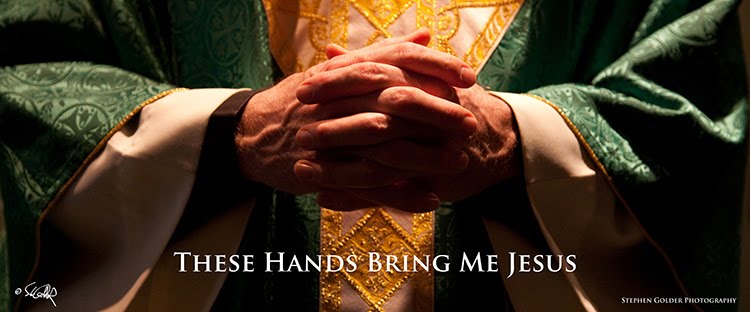
The rhythm of the Mass and of its gestures communicate in a universal way the messages of the Church, as anyone who has heard Mass in a foreign country and an alien tongue will testify. The header of this blog is the title image from These Hands Bring Me Jesus: The Exhibit; it is only one of many images that are Catholic in every sense of the word.
Against the backdrop of a green chasuble, the color of Ordinary time, it is a very familiar image. There is probably no priest, living or dead, who has not assumed this posture at one time or another. The clasped hands are peaceful. They do not grasp or fidget, but rest patiently. Not open in the usual sense, they seem to be waiting to extend themselves in welcome. The fingers are interlaced, but not clenched. There is no anger, no tension, and no need to prove themselves; the hands are authoritative without being overbearing. Entwined with each other, they are ready, expecting to reach out.
It brings to mind a verse of a traditional Irish hymn that links the passage of the day and the passage of life to the strong, patient, loving presence of God:
Lord of all kindliness, Lord of all grace
Your hands swift to welcome, Your arms to embrace
Be there at our homing, and give us, we pray
Your love in our hearts, Lord
At the eve of the day.
In a world that has exploited and diminished, even corrupted, the value of human touch, it is well to remember that it was often by His hands that our Lord communicated His healing grace. He applied a paste of mud to the eyes of a man blind from birth. He touched the ears of the deaf mute. He grabbed Peter by the hand to rescue him from the deep waters when Peter's faith failed. He wrote in the dust to challenge the hearts of those who had caught a woman in adultery. Before He ascended, he stretched out His hands to bless His Disciples.
Subscribe to:
Posts (Atom)


